
Blog
Document AI vs RPA: Which Do You Need?
Document AI reads documents; RPA drives existing software. Compare mapped providers, disclosed budgets and the process each one fits.
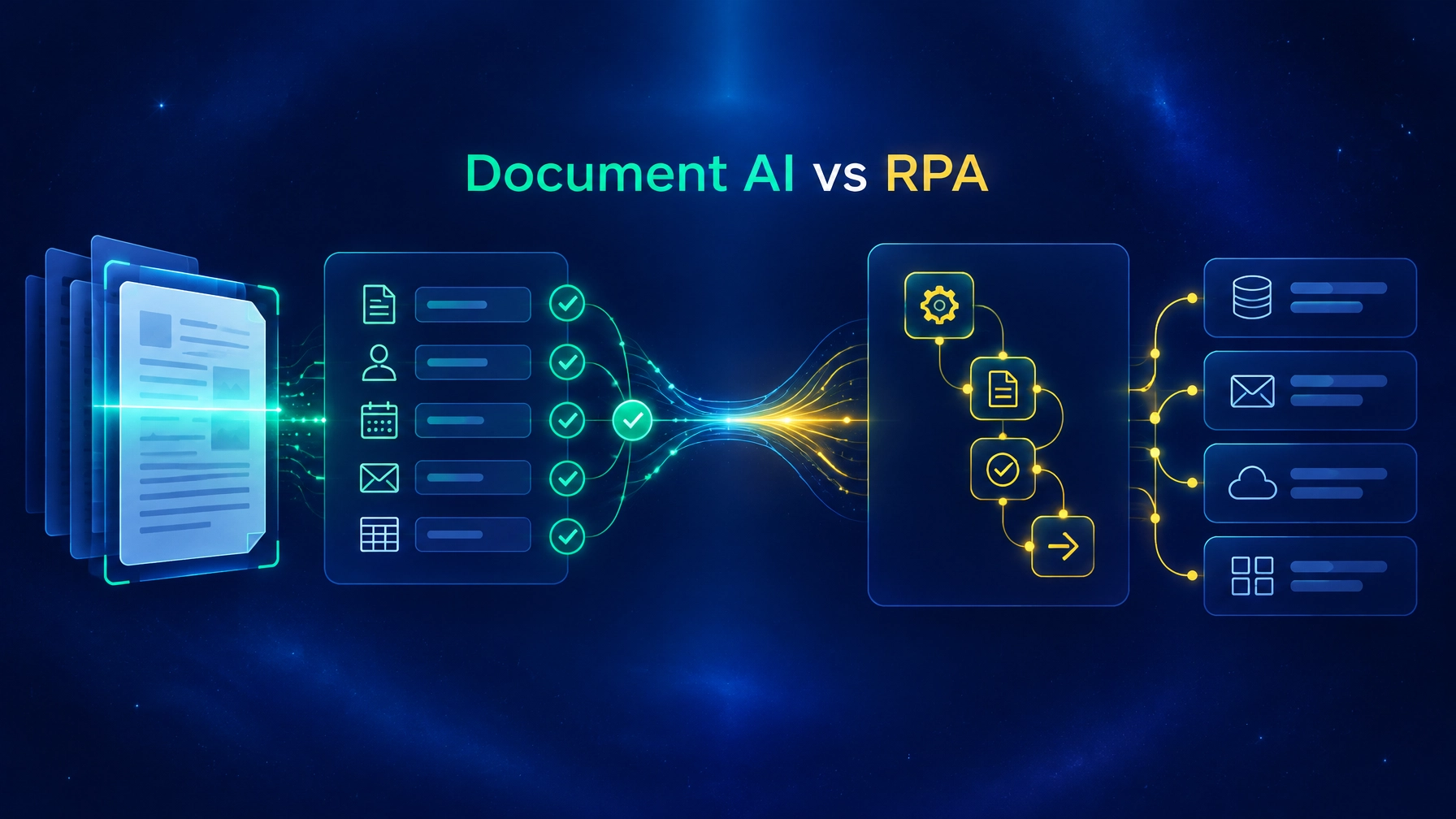
Document AI reads and interprets unstructured documents, then returns structured data. RPA operates existing software interfaces, without requiring APIs, to complete repetitive, rules-based steps. Choose based on the process: use Document AI when document interpretation is the bottleneck, RPA when predictable system actions are; combine them when both are required.
What Does Each Technology Actually Do?
Document AI interprets document content, while RPA executes repeatable actions across software. The distinction is between extracting information from varied inputs and moving known information through an operational workflow.
Document AI can classify documents, extract fields and tables, and return structured information for further processing. Google Cloud’s documentation describes its document processors as supporting digitization, extraction and classification. That does not mean every field is correct: buyers still need to evaluate performance on their own document types and define how uncertain results are handled.
RPA bots follow configured steps through existing applications, such as transferring structured data between screens or creating records. The Automation & Workflow category maps RPA as scripted bots that operate software interfaces without requiring an API. This is useful when integrations are limited and the process follows stable rules.
| Dimension | Document AI | RPA |
|---|---|---|
| What the system reads | Unstructured or semi-structured documents, including scans, PDFs, forms and tables | Existing software interfaces and the structured data or rules presented to them |
| How it integrates | Sends documents to processing software or an API and returns extracted fields for downstream use | Automates repeated actions in existing interfaces; an API is not required for those UI steps |
| Where it breaks | Poor image quality, unfamiliar layouts, ambiguous content or fields that need judgment can reduce extraction reliability | Interface changes, login or permission issues, and process exceptions can interrupt scripted steps |
| What evidence to ask for | Test results on representative documents; field-level accuracy; confidence handling; human-review and exception procedures | A process walkthrough; exception and recovery paths; monitoring, access controls and change-management procedures |
| Typical disclosed budget band | $10K – $50K is the most frequently listed band among firms that disclose a typical budget | $10K – $50K is the most frequently listed band among firms that disclose a typical budget |
These failure modes are evaluation points, not claims that every product will fail in the same way. Ask each provider to demonstrate performance against your inputs and operating environment.
Which Approach Fits Your Process, and Where Does It Fail?
Document AI fits when people must interpret variable documents; RPA fits when people repeat predictable actions in software. If the work contains both problems, a combined workflow may be appropriate.
| Process condition | Starting point | What to verify |
|---|---|---|
| Staff read invoices, claims or forms and re-enter fields | Document AI | Test extraction against your formats, including exceptions and poor-quality scans |
| Staff copy already-structured values between stable systems | RPA | Confirm what happens when screens, permissions or business rules change |
| Documents need interpretation before approved data moves into systems | Document AI plus RPA or API integration | Define review gates, error handling and ownership across each handoff |
A Document AI system does not, by itself, complete every downstream action. An RPA bot does not inherently interpret the meaning of an unstructured document. The choice follows the work being automated, not the vendor’s preferred product label.
What Do Disclosed Budgets and Provider Data Show?
RankGlobal’s published figures show disclosed budget patterns, not project quotes or guaranteed prices. As of 26 Oct 2026, the Document AI category maps 529 providers; 157 have independent client reviews, with 4,437 reviews averaging 4.8/5. These are directory and review signals. They do not establish extraction accuracy or confirm outcomes in your environment.
Of the 152 Document AI firms that disclose a typical project budget, 33% list $10K – $50K, 32% list $25K – $75K, and 20% list $5K – $15K; 4% list $100K+, as of 26 Oct 2026. 377 of the 529 mapped firms do not disclose a budget and are not counted. Budget bands come from each firm’s reviewed Clutch profile, recorded with a link and the date checked; unsourced bands are not counted.
The Document AI pricing guide reports these patterns by firm size:
| Firm size | Firms in sample | Most common listed band | Listing $100K+ |
|---|---|---|---|
| 10 to 49 staff | 33 | $10K – $50K | 0% |
| 50 to 249 staff | 49 | $10K – $50K | 6% |
| 250 to 999 staff | 51 | $25K – $75K | 2% |
| 1,000 or more staff | 16 | $50K – $150K | 13% |
These are observed listings by the firms in each size group, not a rule that larger providers charge more for equivalent work. Among the 200 Document AI firms that disclose headcount, 80% have 50 or more staff and 2% are teams of 10 or fewer, as of 26 Oct 2026.
The RPA skill page maps 216 providers; 69 have independent client reviews, with 1,909 reviews averaging 4.8/5, as of 26 Oct 2026. Of 64 RPA firms disclosing a typical budget, 38% list $10K – $50K, 33% list $25K – $75K, and 14% list $5K – $15K; 5% list $100K+. The same date’s headcount data shows 81% of the 91 firms that disclose headcount report 50 or more staff, while 2% are teams of 10 or fewer.
In both categories, a budget band is the typical engagement size a firm states on its profile or website. It is not a quote and is not a price RankGlobal sets. Bands overlap, so the data reports how frequently firms list each band rather than an average.
Category boundaries also matter. As of 26 Oct 2026, Automation & Workflow maps 1,305 providers; 369 have independent client reviews, totaling 9,982 reviews averaging 4.8/5. Within that category, mapped skills include Workflow Automation (906 providers), Intelligent Automation (427), Robotic Process Automation (216), and Business Process Automation (267). These skill counts are classifications, not exclusive market segments; capabilities can overlap.
When Does a Combined Workflow Make Sense?
A combined workflow makes sense when a process must interpret a document and then carry out repeatable actions in business systems. For example, document processing can extract invoice fields; a person can review exceptions; automation can then transfer approved data into finance software.
Use this sequence to scope a pilot:
- Map the current work. Identify document inputs, decisions, systems touched, exceptions and points where staff intervene.
- Separate interpretation from execution. Mark which steps require extracting or classifying document content and which follow stable rules.
- Set review and control points. Define which fields require human confirmation, how errors are corrected, and who can approve downstream actions.
- Test with representative cases. Include ordinary inputs and known exceptions. Record what succeeded, what needed review and what could not be processed.
The purpose of a pilot is to measure the specific process, not to confirm a broad vendor claim. For governance, the NIST AI Risk Management Framework is voluntary and NIST says it is being revised. The EU AI Act applies in stages: most of its rules from 2 August 2026, some earlier and some later. Legal classification depends on intended purpose and use, not simply on whether a tool is called Document AI or RPA. The UK ICO’s AI and data protection guidance is under review, so check for current updates when assessing a UK deployment.
How Should You Assess Providers and Shortlist Options?
Assess providers by the evidence they can show for your process, then compare their scope, specialization and stated engagement context. The firms below follow the Document AI category ranking: firms with direct evidence for at least one document AI skill, ordered by independent client reviews (published about each firm on Clutch), then rating. Within that list the order is by reviews, not by specialisation.
| Firm | Independent reviews / rating | Specialisation | Typical budget | Team size | Headquarters |
|---|---|---|---|---|---|
| Hyperlink InfoSystem | 174, 4.8/5 | 2% (1 of 44 skills) | $25K – $75K | 1,000-9,999 staff | Ahmedabad, India |
| TechAhead | 125, 4.9/5 | 2% (1 of 43 skills) | $25K – $75K | 50-249 staff | Agoura Hills, United States |
| The NineHertz | 123, 4.8/5 | 5% (3 of 66 skills) | $25K – $75K | 250-999 staff | Jaipur, India |
| Suffescom | 121, 4.9/5 | 4% (2 of 52 skills) | $25K – $75K | 250-999 staff | New York, United States |
| Saritasa | 108, 4.8/5 | 6% (1 of 17 skills) | $50K – $150K | 50-249 staff | Newport Beach, United States |
Treat these profile details as discovery information, not a recommendation or confirmation of availability. Before shortlisting, ask each firm to demonstrate relevant document handling, integration design, exception management, security controls and post-deployment ownership. Review counts and ratings describe published review records; they do not replace technical validation. For a step-by-step evaluation, see the Document AI how-to-choose guide.
A defensible decision starts with a clear process map. Choose Document AI for document interpretation, RPA for predictable software actions, and combine them only where the workflow requires both. See RankGlobal’s research methodology to understand how provider information and rankings are assessed.
- RankGlobal Research Team
Sources
- Google Cloud: Document AI overview, official product documentation on document processing, extraction and classification.
- Digital.gov: Understanding Robotic Process Automation, U.S. government guide to RPA uses and characteristics.
- NIST: AI Risk Management Framework, voluntary framework for managing AI risks; NIST notes that it is being revised.
- Regulation (EU) 2024/1689, Artificial Intelligence Act, official EU legal text.
- UK ICO: Guidance on AI and data protection, regulator guidance currently under review.